What makes a dish a special?
A restaurant special is a dish or drink offered outside the usual menu, often for a limited time. It might appear on a printed insert, a board or a server’s spoken list. The word “special” describes how the item is offered, not necessarily its size, value or quality. Some specials are familiar dishes with one ingredient changed; others are preparations that do not fit the regular menu.
There are many practical reasons for a changing offer. A kitchen may have an ingredient that suits a short run, want to try a new combination or have the capacity to make something that would be difficult to offer every day. A special can also give regular guests a different choice. None of these possibilities tells you, on its own, whether the dish is right for you.
Get the full picture, not just the appealing description
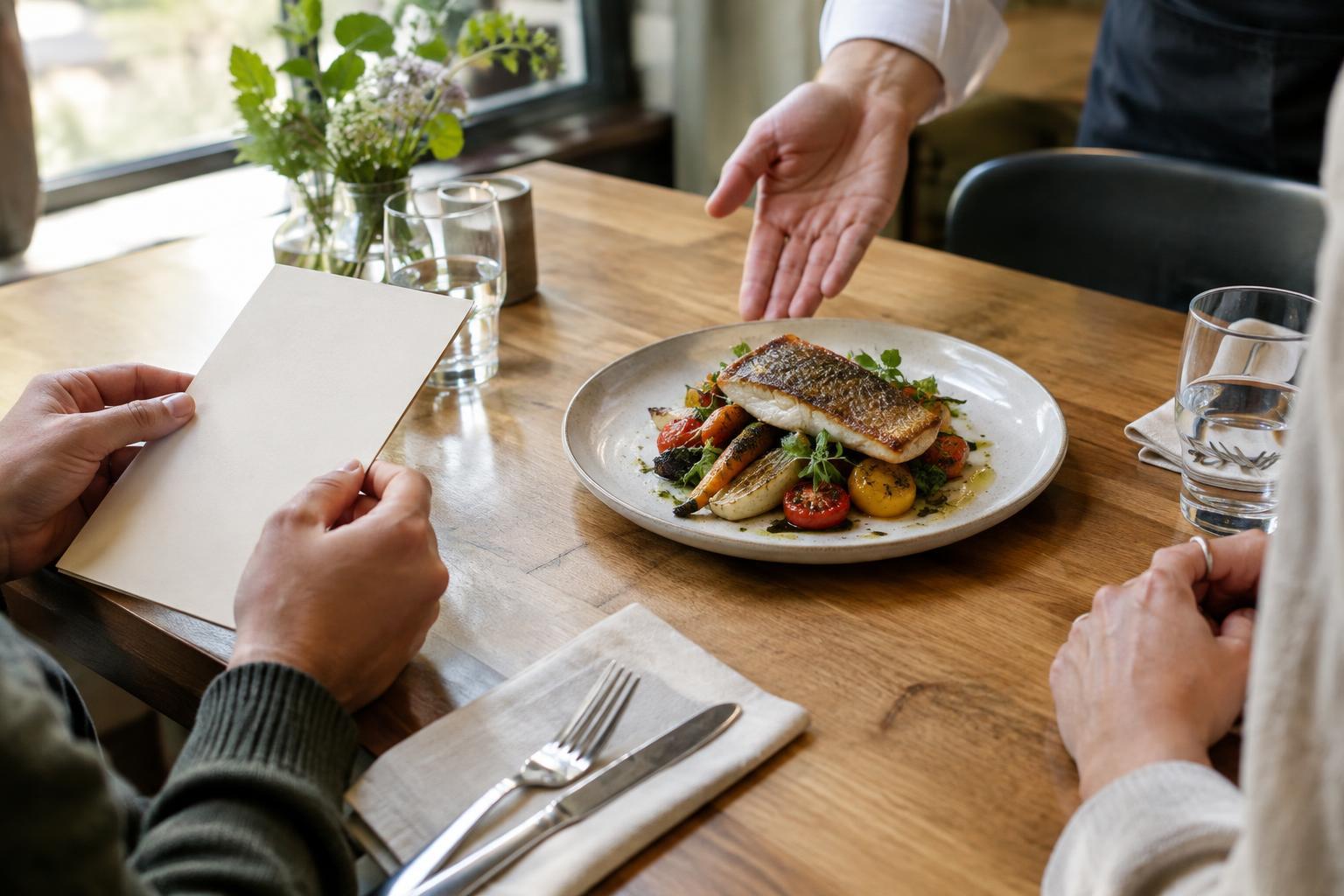
A spoken special can be hard to absorb, especially when several dishes are described at once. It is fine to ask for the description again. Start with the basics: What is the main ingredient, how is it cooked and what comes with it? A phrase such as “market fish with vegetables” leaves room for several different preparations. Knowing whether the fish is grilled or fried, and whether the vegetables are a garnish or a substantial side, makes the choice easier.
Price is worth asking about before ordering if it has not been stated or printed. A special may cost more, less or about the same as a comparable menu item; there is no dependable rule. You can ask simply, “What is the price of that dish?” If you are choosing between two options, asking whether the special is intended as a starter or a main can also help you judge the portion.
If an ingredient matters to your diet or you have an allergy, explain your needs clearly rather than relying on a short description. Ask staff to check the ingredients and preparation details with the kitchen when needed. A special may be less familiar to the person describing it, so it is better to pause for a clear answer than to guess.
Decide how it fits the rest of the meal
The most tempting description is not always the best order for the table. Think about how the special fits with what you already plan to eat. A rich main may pair better with a lighter starter, while a small special could make sense as one of several shared plates. If you are sharing, check whether the dish can be divided comfortably and whether its serving size suits the group.
Timing can matter too. Some dishes take longer because they are cooked to order or require a particular preparation. If you are on a schedule, ask whether the special is likely to take longer than the other dishes you are considering. The answer may depend on the kitchen at that moment, but asking gives staff a chance to set expectations.
You do not need to order a special simply because it sounds scarce or receives an enthusiastic description. Compare it with the regular menu using the same questions you would ask of any dish: Do I like the ingredients? Is the preparation what I want? Does the price work for this meal? A familiar menu choice can be just as satisfying.
Ask comfortably and leave room for a simple answer
Questions about a special are part of ordering, not a challenge to the person serving you. Keep them specific so staff can answer or check: “Is there dairy in the sauce?” is more useful than “Is it light?” If you need time to decide, you can ask for a moment to look over the menu. If an answer is uncertain, choose an option you can evaluate more confidently.
A good special offers another possibility, not a test of whether you know the right thing to order. Once you understand the ingredients, preparation, portion and price, you can decide whether it adds something you want to the meal. And if it does not, passing on it is a perfectly reasonable choice.