Why oil and vinegar need help
Pour oil and vinegar into a jar and leave them alone: the oil rises, and the vinegar settles below. Water-based liquids such as vinegar do not readily mix with oil. An emulsion is a mixture in which tiny droplets of one liquid are dispersed through the other. In most vinaigrettes, droplets of oil are suspended in the watery portion, which may include vinegar, citrus juice or another acidic liquid.
Whisking or shaking breaks the oil into smaller droplets. The more thoroughly those droplets are dispersed, the more evenly the dressing tastes and coats food. But mixing alone does not necessarily make it last. Droplets can join back together, leaving a layer of oil on top. That is normal for a simple vinaigrette, not a sign that the recipe has failed. A shake just before serving may be all it needs.
What makes an emulsion last longer
An emulsifier helps oil and water-based ingredients stay mixed by sitting at the boundary between them. Mustard is a familiar example in vinaigrette: even a small spoonful can make a dressing look more uniform and cling better to leaves. Egg yolk plays a similar role in mayonnaise-style dressings. These ingredients also contribute flavor and body, so the choice should suit the dish.
Thickness matters, too. A thick base slows the movement of oil droplets, making it harder for them to meet and merge. Yogurt, mayonnaise or a smooth vegetable purée can give a dressing a creamy texture while helping it hold together. A creamy appearance does not always mean a dressing contains dairy; finely dispersed oil droplets can make an emulsion look pale and opaque. Nor does a thick dressing automatically stay mixed forever. Its texture depends on the ingredients and how they were combined.
Building a vinaigrette that coats rather than pools
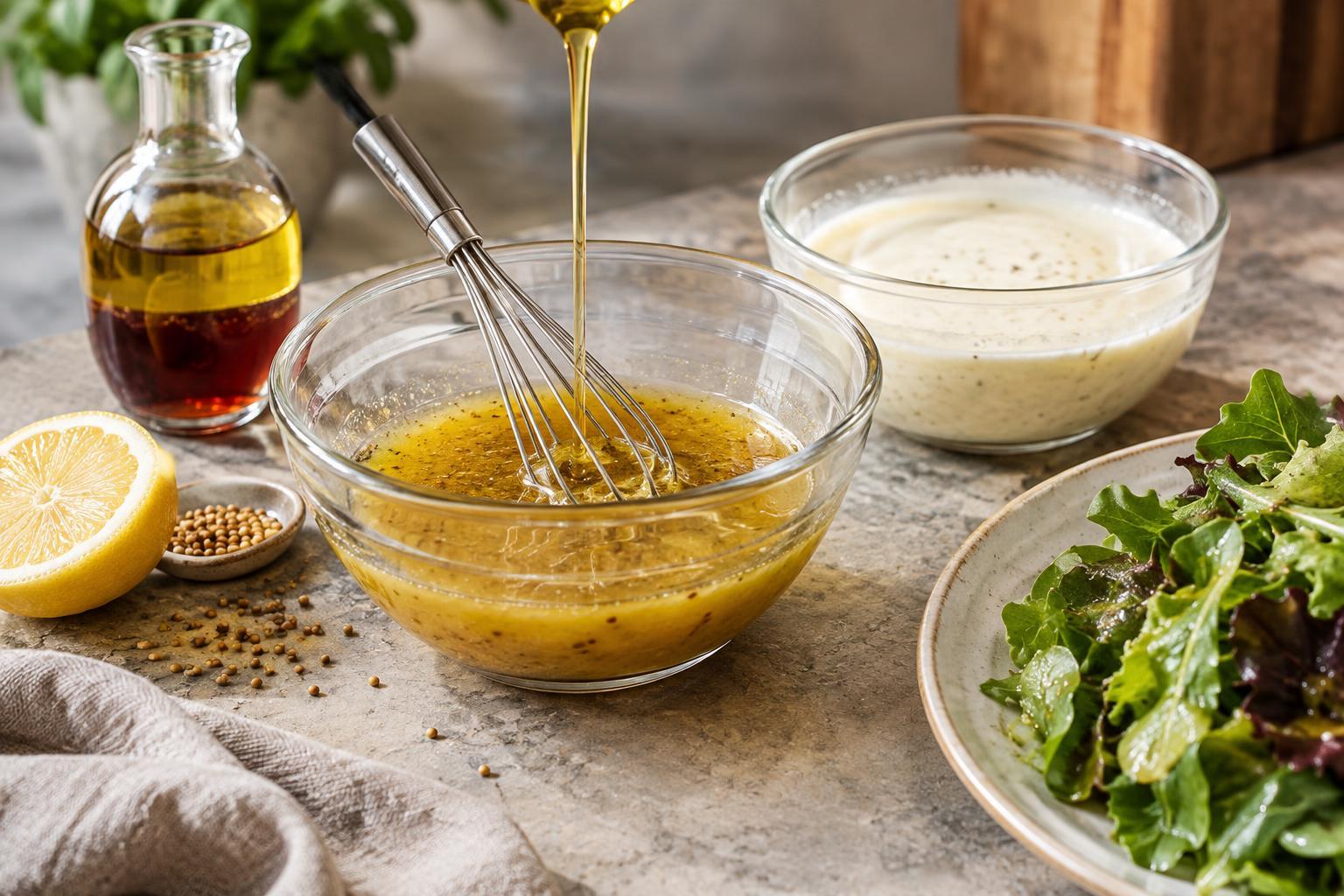
For a basic vinaigrette, start with about three parts oil to one part vinegar or citrus juice, then adjust to taste. A sharp vinegar may need more oil, while a mild one may allow less. First stir salt into the acidic liquid so it can dissolve, then add mustard if you want it. Whisk while pouring in the oil gradually. Starting slowly helps distribute the oil as small droplets; once the dressing has some body, you can add the rest more steadily.
A lidded jar offers an easy alternative: add everything, close it securely and shake until the dressing looks uniform. Taste it on a leaf or a piece of the food you plan to serve, not only from a spoon. Greens, grains and roasted vegetables change how its acidity and saltiness come across. If it tastes flat, it may need more salt or acid. If it feels harsh, add a little more oil and mix again.
Making a creamy dressing without losing control
Creamy dressings are easiest to manage when you begin with a smooth base. Whisk vinegar or lemon juice and seasonings into yogurt or mayonnaise, then add oil gradually if the dressing needs more richness. For a spoonable sauce, use less liquid; for a dressing that can be drizzled, thin it a little at a time with water or an acidic ingredient. Small additions make it easier to stop at the texture you want.
The order matters most when you are asking the mixture to hold a substantial amount of oil. Adding too much oil before it has been dispersed can leave visible slicks or a grainy-looking dressing. If that happens, do not keep adding oil in the hope that it will smooth out. Start with a spoonful of the intended base in a clean bowl, then slowly whisk the split mixture into it. This gives the droplets another chance to disperse.
Choosing the right texture for the table
A lightly mixed vinaigrette is useful when you want distinct flashes of oil and acid, as with sliced tomatoes or bitter greens. A more stable emulsion suits a salad that needs even coating or a platter that may sit briefly before serving. Creamy dressings bring weight and cling to sturdy leaves, crunchy vegetables and grain bowls. None is inherently better: the food and the moment determine the best texture.
Dress the food close to serving time when crispness matters, and add only enough to coat it. Keep extra dressing separate so guests can adjust their portions. If a stored vinaigrette separates, shake or whisk it again and taste before using; flavors and texture can seem different after resting. Once you understand that an emulsion is a balance of droplets, mixing and supporting ingredients, dressing becomes less of a fixed formula and more of a technique you can adapt.