Start with the result you want
Knife cuts are often described as a test of precision, but home cooking rarely requires a ruler. The useful question is what the ingredient needs to do in the dish. Small pieces can soften quickly and spread through a sauce; larger ones retain more texture. Thin pieces are easy to fold, layer or eat in a single bite. Pieces of a similar size tend to cook at a similar pace.
Set up a stable cutting board, use a sharp knife you can control, and give yourself room to work. If an ingredient rolls, cut a small flat side before making finer cuts. Keep the fingertips of your guiding hand tucked back, and move at a pace that lets you see where the blade is going. Consistency matters more than speed.
Slices: for even cooking and deliberate layers
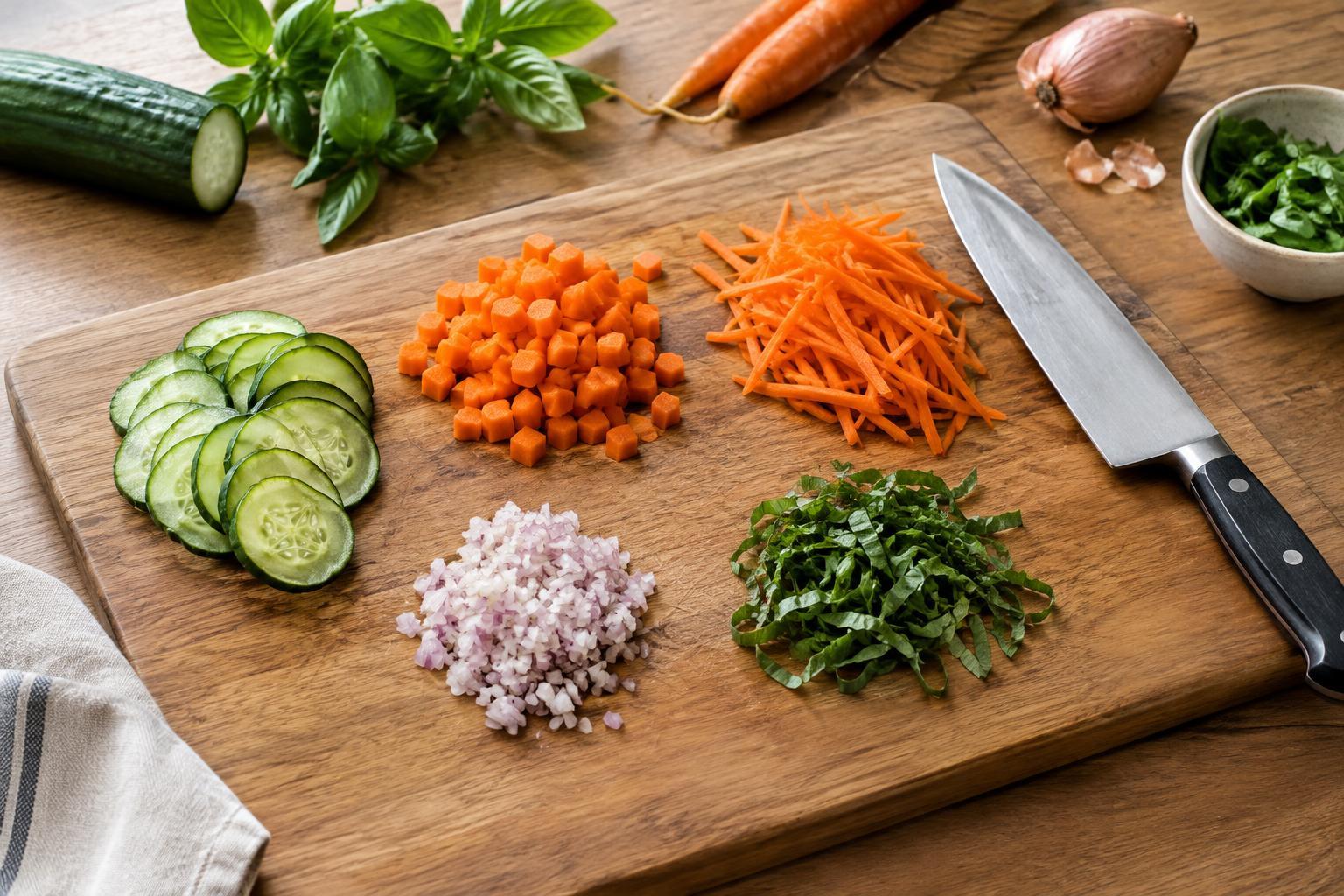
Slicing means cutting an ingredient into relatively flat pieces. Thin onion slices soften readily in a pan, while thicker slices hold their shape better on a tray of roasted vegetables. Tomato and cucumber slices can be layered in sandwiches or arranged on a plate. The best thickness depends on whether you want the ingredient to melt into the dish or remain distinct.
For an onion, halve it through the root and place a cut side on the board before slicing. For a carrot or other firm, narrow vegetable, make an initial cut that gives it a stable resting surface if needed. Try to keep the slices roughly alike, especially when they will cook together. Perfect circles and identical edges are less important than a thickness suited to the cooking method.
Dices: for texture that fits the dish
A dice produces small, roughly cube-shaped pieces. A fine dice of onion, celery or carrot can form an unobtrusive base for a soup or sauce. A larger dice gives a stew recognizable pieces to spoon up. Even size helps, but the right size is the one that makes each bite pleasant: tiny potato cubes may disappear into a long-cooked dish, while very large ones may be awkward in a quick skillet meal.
To dice a firm vegetable, cut it into manageable sections, make slices, stack a few slices safely, cut them into strips, then cut across the strips. There is no need to stack more than you can hold securely. For irregular ingredients, aim for pieces of comparable thickness rather than forcing every piece into a perfect cube.
Matchsticks, mince and ribbons: cuts with specific jobs
Matchsticks, sometimes called julienne, are thin strips that work well when you want crunch without a bulky bite. Try them with carrots in a slaw, cucumber in a rice bowl or firm vegetables in a quick stir-fry. Make thin slices first, then cut those slices into strips. Because the strips are slender, add them to a hot pan with their short cooking time in mind.
Mincing creates very small pieces that distribute strong flavors. Garlic, ginger and fresh herbs are common candidates. Chop the ingredient, gather the pieces, and cut through them again until they are small enough for the dish. A coarse mince can give a dressing noticeable bits; a finer one spreads flavor more evenly. Take care with delicate herbs, which can bruise if worked more than necessary.
Ribbons are useful for broad leaves such as basil. Stack or loosely roll dry leaves and slice across them with a sharp knife. The resulting strips are easy to scatter over pasta or salad. Cut them close to serving if you want them to look fresh, and choose wider ribbons when you want the leaves to remain noticeable rather than blend into a garnish.
Let cooking time guide the final cut
Before you pick up the knife, consider how long the ingredient will cook and how it will be eaten. For a quick sauté, cut dense vegetables smaller or thinner than tender ones, or add them to the pan earlier. For a slow braise, larger pieces may be better able to keep their identity. In an uncooked salad, aim for shapes that are comfortable to pick up with a fork and combine in one bite.
A recipe’s named cut is a helpful starting point, not a reason to discard usable pieces. If your dice is uneven, separate noticeably larger pieces and give them a little more cooking time. With practice, the goal is not a display of knife skills. It is a dish in which the ingredients cook as intended and feel good to eat.