Why eggs respond so quickly to heat
An egg changes texture as its proteins unfold and join together. Gentle heat forms a loose network that holds moisture; too much heat tightens that network and squeezes moisture out. That is why a scramble can look glossy one moment and dry the next. Temperature matters, but so does time: an egg left over moderate heat may become firmer than one briefly exposed to a hotter surface.
Whites and yolks do not set in exactly the same way. Whites begin turning opaque at a lower temperature than yolks become firm, which makes a poached egg with a set white and flowing yolk possible. Added liquid changes the picture again. Milk or cream dilutes the egg proteins in custard, allowing a softer set at a higher cooking temperature than you might expect from a plain egg. Use the ranges below as guides rather than promises; pan thickness, egg size and the accuracy of a thermometer all affect the result.
Tender scrambles: control the pan, then stop early
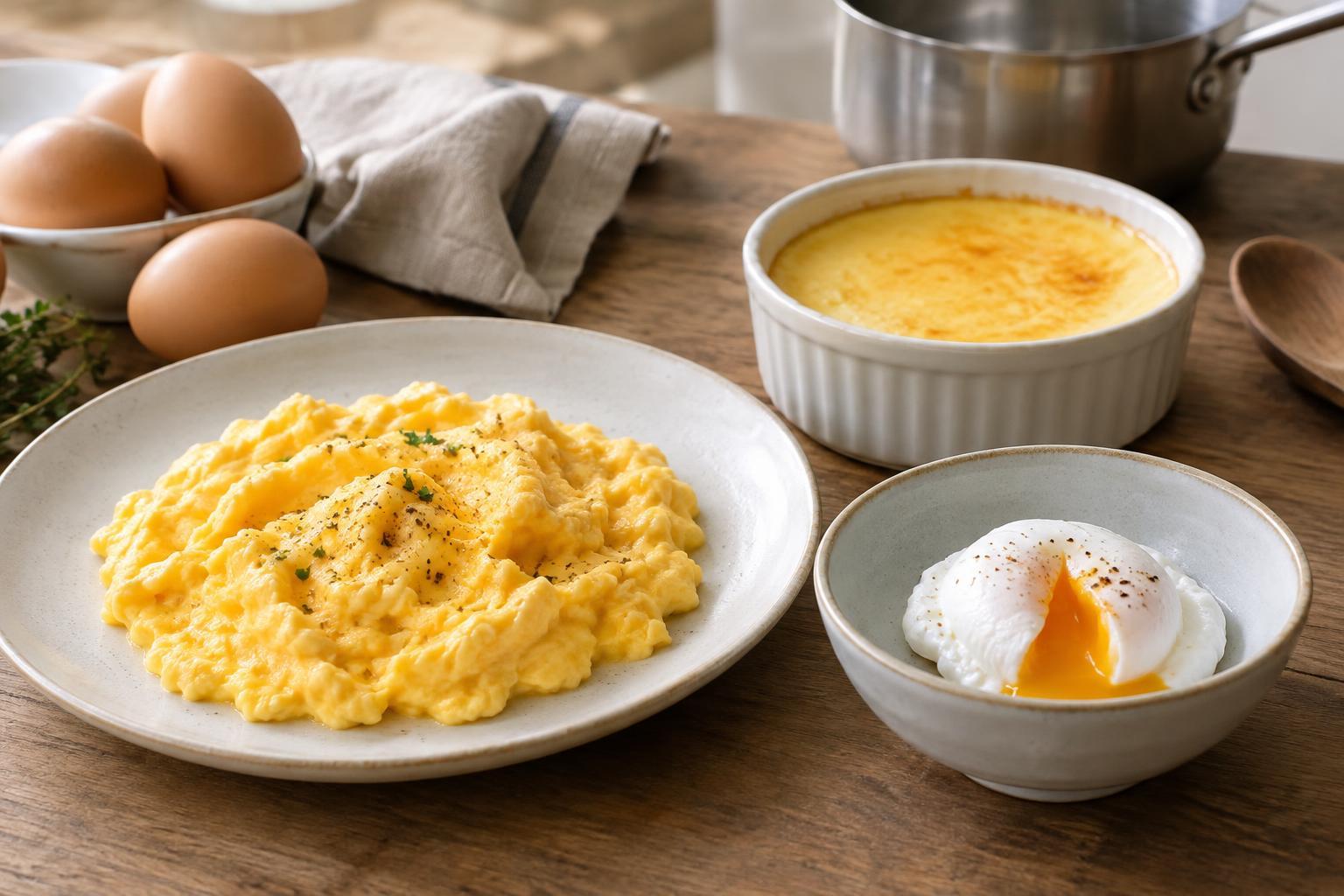
For soft scrambled eggs, the most useful setting is low to medium-low heat. Beat the eggs until the whites and yolks are combined, then pour them into a lightly buttered pan. Stir or sweep the eggs regularly, bringing the cooked portions toward the center while uncooked egg reaches the pan. If large, dry sheets form as soon as the eggs touch the surface, lower the heat or lift the pan off the burner for a few seconds.
Take the pan off the heat when the curds are formed but still look slightly glossier than you want to serve them. Residual heat in the pan and eggs will continue the cooking. A cool plate helps stop that process sooner than leaving the eggs in the skillet. For smaller, softer curds, stir more frequently; for larger folds, stir less often. Neither style requires a precisely measured pan temperature—the pace of setting is a better guide.
Soft texture and food safety are separate considerations. General food-safety guidance commonly calls for egg dishes to reach 160°F (71°C). Scrambles served very loose may not reach that temperature throughout. If a diner needs to avoid undercooked eggs, use pasteurized eggs when appropriate and follow the food-safety guidance that applies to them.
Poached eggs: keep the water below a vigorous boil
For poaching, aim for hot water with gentle movement rather than rolling bubbles—roughly 175–190°F (80–88°C) is a useful working range. A vigorous boil can tear the white apart, while water that is too cool lets it spread before setting. Crack an egg into a small cup first, then lower it close to the water and slip it in. Fresh eggs tend to have firmer whites that hold together more readily, although older eggs can still be poached.
Cook until the white is opaque and holds its shape when lifted with a slotted spoon. The yolk may remain fluid even when the white looks set, so judge both texture and the needs of the person eating it. A runny-yolk poached egg is not fully cooked; anyone avoiding undercooked eggs should choose an appropriate alternative, such as an egg cooked until both white and yolk are firm. Drain a finished poached egg briefly so excess water does not dilute the dish beneath it.
Custards: watch the mixture, not just the clock
A stirred custard, such as a pouring sauce, benefits from steady, moderate heat and constant movement. Many begin to thicken noticeably around 170–180°F (77–82°C). Stir across the bottom and corners of the pan, and remove it from the heat once the custard lightly coats a spoon. Continued heating can turn a smooth sauce grainy as the proteins clump. If the pan holds heat, pour the custard into a cool bowl promptly rather than letting it sit.
Baked custards need a gentler approach because the edges heat before the center. A water bath can moderate that difference: place the filled baking dishes in a larger pan and add hot water around them before baking. Look for set edges and a center that still moves as one soft mass when the dish is nudged, not a liquid ripple. The center will continue to firm as the custard cools.
A thermometer is especially useful when you are learning a recipe, but place it in the custard rather than against the pan or baking dish. Recipe proportions determine the best endpoint, so follow a tested recipe’s temperature guidance when one is provided. Across all three methods, the same habit pays off: apply heat gently, check the texture often and allow for the cooking that continues after the heat is removed.