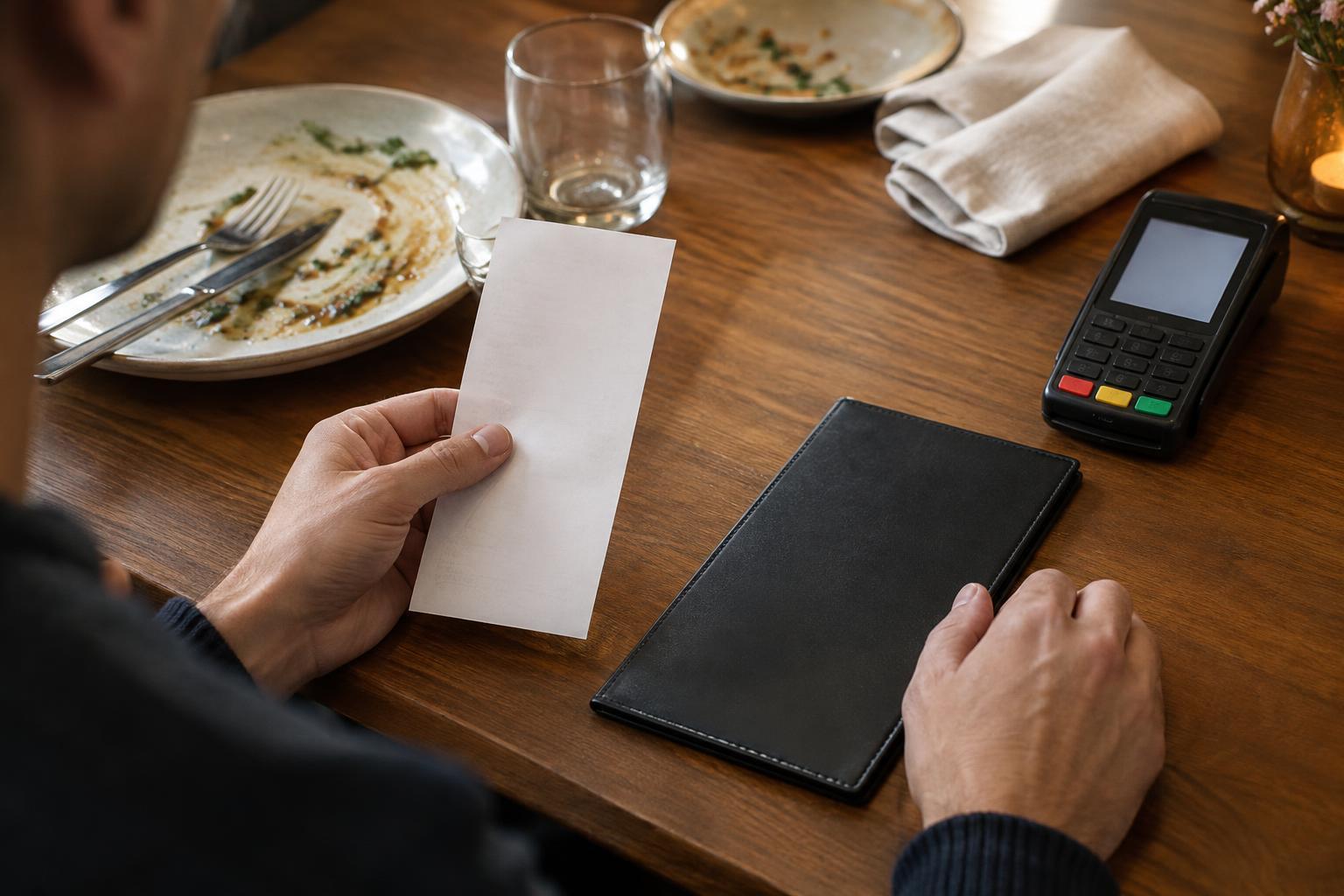
Start with the itemized check
The end of a meal is not the easiest moment to study fine print. People are gathering coats, the table is settling up, and a payment screen may be waiting. Still, a brief look at the itemized bill can prevent confusion—especially when a restaurant adds a charge before offering a tip prompt.
First, check that the food and drinks match what the table ordered. Then look below the subtotal for taxes, fees and any line labeled “gratuity,” “service charge,” “hospitality charge” or similar. These labels matter more than the size of the line: two charges with the same percentage may serve different purposes. If you are paying for only part of a shared meal, confirm how the charges have been divided before approving your portion.
Know what the labels may mean
A tip is an amount a guest chooses to leave, often entered on a receipt or payment screen after the bill is presented. A suggested tip is only a calculation offered for convenience; it is not necessarily an amount already added to what you owe. Check the total rather than assuming the suggested figures represent a charge.
An automatic gratuity is added to the bill without the guest entering it at payment. Restaurants may use one for a large group or a particular dining format. A service charge is also added by the business, but the phrase alone does not tell you who receives the money or how it is used. Practices and terminology vary by restaurant and location, so it is worth reading any explanation on the menu or bill. Do not assume that a service charge is a tip for your server—or that it is not.
Read the total before using the tip screen
The payment screen may ask for a tip even when an automatic gratuity or service charge is already on the check. That does not, by itself, mean you are expected to add another amount. Compare the screen’s starting total with the itemized bill, and see whether the charge is included. If you want to leave something extra, make it a deliberate choice rather than a response to a preset button.
Tip suggestions can also be calculated from different starting amounts. Depending on the system, a suggested percentage might be based on the subtotal, a total that includes tax, or another figure. If that distinction matters to you, use the itemized amounts to work out the amount you intend to leave. You can usually select a custom amount rather than choosing a preset percentage.
Ask a short, specific question when needed
If a line is unclear, a calm question is more useful than guessing. Try: “Is the service charge already included in this total?” or “Does this charge replace a tip, or is an additional tip optional?” If you want to know how a charge is handled, ask how the restaurant describes its purpose. Staff may not be able to explain every payroll detail at the table, but they can often clarify the bill or find someone who can.
This is particularly helpful with group meals, private dining and fixed-price menus, where payment terms may have been set before anyone sat down. Check the booking details or menu as well as the final bill. If something appears twice, point to the specific lines and ask for a corrected check before paying.
Make the last step intentional
A simple routine keeps the decision manageable: verify the order, find any added charge, read its description, check the payment screen, then choose whether to add a tip. Save or photograph an itemized receipt if you need a record of how a shared bill was settled.
Good hospitality includes a clear bill, and guests should not feel awkward asking what they are paying for. Taking a moment to read the charges respects both your budget and the people serving the meal: it lets you pay the amount you actually mean to pay.